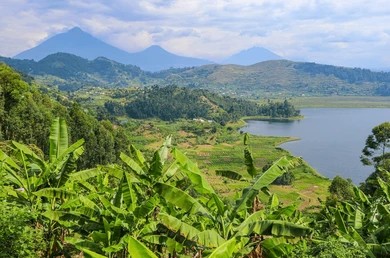
The history of Kitara empire and its associated cultures (which altogether can be called Kitara civilzation) is closely linked to its unique geography. In this article, we will see how the localisation of the Kitara civilization influence its destiny.
The craton, an old part of the earth crest.
The East African craton is about 3 billions years old. It is a part of the eart crest which maintain its integrity despite the geological movements and plate tectonics. This geological part contains specific elements coming from the interior of the Earth, such as rare minerals, hence explaining the important mineral resources of the area.
A localisation at the Equator.
The Kitara region is located at the Equator, which bring warmth and humidity. This is warm and sunny region due to its location with high solar energy radiation. However, its equatorial location brings also an accumulation of clouds, leading to high humidity.
A plateau of high altitude.
The East African Plateau is located about 1000 meters above the sea level. This altitude bring a more temperate climate compared to lower altitude areas.
A unique geological phenomenom. The Rift Valley.
In this region, powerful telluric forces have shaped the Earth and put in movement continental blocs. Masses of land rise up, forming towering mountains, while other regions collapse and sink, creating escarpments, crevasses, and gigantic trenches soon filled with vast bodies of water. These are the African Great Lakes.
At the summits of the high mountains, above 5,000 meters, glaciers form, giving these places the appearance of polar ice fields and covering the mountains with a majestic white and gleaming crown. During the warm season, the waters from these glaciers flow down as streams and then rivers, emptying into the great lakes.
These high-altitude lakes, filled and interconnected, pour into a great river that flows from the high regions of Africa toward the lowlands of the North: the Nile.
The sources of the Nile.
The question of the sources of the Nile was one of the great mysteries of Antiquity. Egyptians, Greeks, and Romans alike explored in search of the Nile’s source. All that the Ancients knew was that the Nile originated at the foot of the Mountains of the Moon.
Today, the farthest known source of the Nile has been identified. It is the Rukarara River, located in the Nyungwe Forest, at an altitude of 2,500 meters in southwestern Rwanda. From the heart of Kitara, the Nile (which also bears the local name Kiira in the region) flows northward, leaving the Great Lakes region to cross Africa and the Sahara before finally emptying into the Mediterranean Sea. Along its course, it spreads life, enabling many African peoples to live and prosper. As Herodotus stated: “Egypt is the gift of the Nile.”
A garden in the heart of Africa :
Kitara is the crossroads of several regions of Africa. It lies at the intersection of the Nile Valley, the Horn of Africa, the Great Congo Forest, the West African savannas, and the subequatorial savannas. It is the passageway between the north and the south of the continent. The region is a land of fertile soils, enriched by its volcanic environment. Its flora is diverse, rich in fruit trees and grasses, with numerous gallery forests, prairies, and grassy savannas. Lakes, marshes, rivers, and great waterways abound. The Great Lakes are the defining feature of the region: Nyanza, Tanganyika, Kyoga, Kivu, Rwitangize, Rweru… all these immense lakes are sources of life for the societies living along their shores.
The fauna is equally rich, with large mammals such as elephants, giraffes, lions, rhinoceroses, zebras, and impalas, as well as reptiles (crocodiles and lizards), birds, insects, and fish. The region is enclosed by two major geological formations: the Eastern Rift and the Western Rift. These two systems are dotted with immense mountains and volcanoes, all rising above 4,000 meters: Mount Kenya, Rwenzori Mountains, Virunga Mountains, and Mount Elgon (also called Mount Masaba). These mountain ranges were what the Ancients referred to as the Mountains of the Moon.
As we see, this region forms a kind of natural garden in the heart of Africa, favorable to plant life, animal life, and human activities. It was within this unique region that the civilization of Kitara emerged.


Leave a Reply