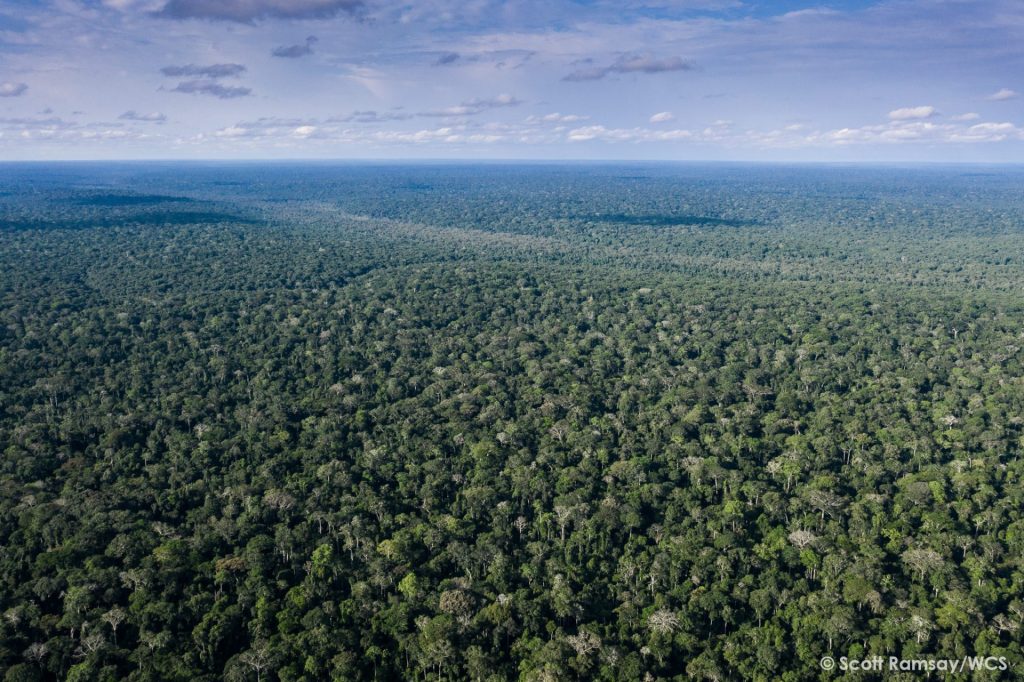
According to the Bantu expansion theory, Bantu migrate from Mount Cameroon towards Central, Eastern and Southern Africa by crossing the Equatorial forest.
The Equatorial Forest of the Congo basin is the second largest rainforest in the world, after the Amazonian forest. It covers an area of more than 2 million square kilometers, from the Atlantic Ocean to the Great Lakes region. This area is home to more than 10 000 plants species and about 10 000 animal species. The area includes lowland forests, swamp forests, savannah forests, and a complex system of rivers (Uele, Ubangui, Ogoué, Sangha, Kasai) centered around the powerful Congo river.
The region is scarcely populated and inhabited mostly by nomadic hunter-gatherers people such as the Akka or Mbuti.
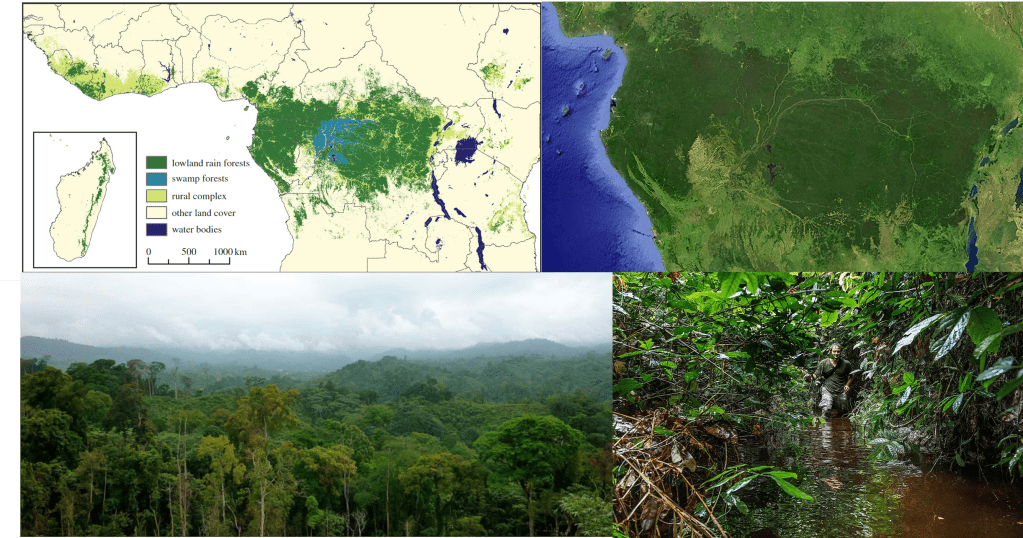
From a geographical point of view, the Equatorial rainforest act as a natural barrier, a major physical obstacle which hinder any important migrations. It’s an area only inhabitable by hunter-gatherers who have adapt to this environment and can resist its complex nature. Agricultural populations would not be fitted to live or even migrate in this environment. The image below shows the caracteristics of the Equatorial forest : its extension, its high density of vegetation, the presence of many marshs and swamp areas.
An example of the harsh nature of the rainforest environment can be seen through Stanley exploration journeys. Around 1876, the American adventurer Stanley, during his first exploration of Central Africa, tried to cross the Equatorial forest from East to West, by sailing down the Congo river. This expedition across the Equatorial forest turned into one of the most dramatic expedition ever conducted. During the journey, diseases pop up, wars occured with surrounding tribes, fierce animals were eveywhere, most of the goods were destroyed by humidity or insects, and at the end of the trip, nearly half of the group has died, with most of the surviving travellers suffering from illness and deeply exhausted. This event give a glimpse of what would have look like a series of migrations spanning over centuries across the Equatorial rainforest : a demographic catastroph.
With all these elements considered, it’s highly unprobable that important migrations occured through the Equatorial forest. As the Sahara desert, the Equatorial rainforest acts as a natural barrier, making it nearly impossible for important groups to migrate through it.
To conclude, we see here that the hypothesis of the Bantu people migrating in mass through the Equatorial forest is very unlikely, and the hypothesis could be considered that this migration never happened.
In the next chapter of this serie, we will analyse the linguistic situation of current inhabitants of the Equatorial rainforest, known as Pygmy or Twa people, and how comes that most of these Pygmy or Twa groups speak a Bantu language. To say otherwise : What is the original Pygmy/Twa language ?

 Empire of Kitara
Leave a comment