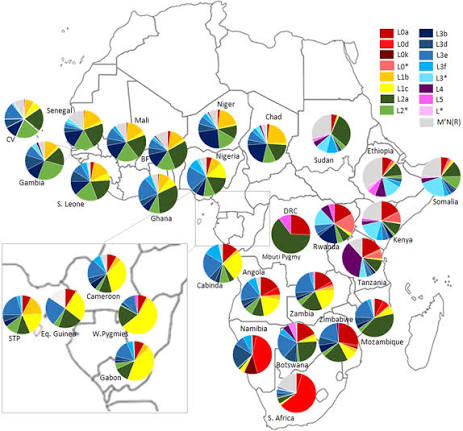
In this article, we will analyze what genetic studies tell us regarding the Bantu populations and their history and if there are elements supporting a mass migration from Mount Cameroon.
Genetic studies indicate :
- Bantu populations have a great genetic homogeneity
Genetics and Demographic History of the Bantu. Rocha, Fehn. 2016
This article discuss the genetic panorama of Bantu groups and show that Bantu populations display a strong genetic unity and have clear genetic relations with other Niger-Congo people. The main Y-DNA among Bantu and other Niger-Congo populations is E1B1a (see figure below). For the maternal DNA, the situation is more diverse with most frequent haplogroups being L0a, L1c, L2b, L3b and L3e.
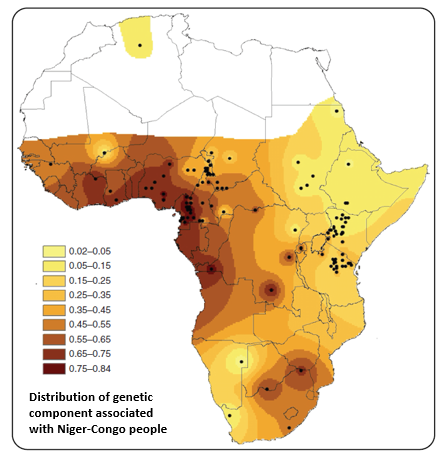
However the available genetic evidence has not provided robust elements to support the migratory routes of the Bantu expansion (early or late-split model).
Moreover, as shown in the picture above, one can see that the genetic component associated to Niger-Congo expansion is confined to the Atlantic coast and is not matching the Bantu spread area, indicating a complex genetic history where many Bantu populations have a noticeable genetic distance from other Bantu groups.
- South-East Bantu population constitute a specific genetic group within Subsaharan populations
Genome-wide SNP analysis of Southern African populations provides new insights into the dispersal of Bantu speaking groups. Gonzales-Santos & al. 2015
This article shows the genetic landscape of Subsaharan populations and indicate well defined subgroups :
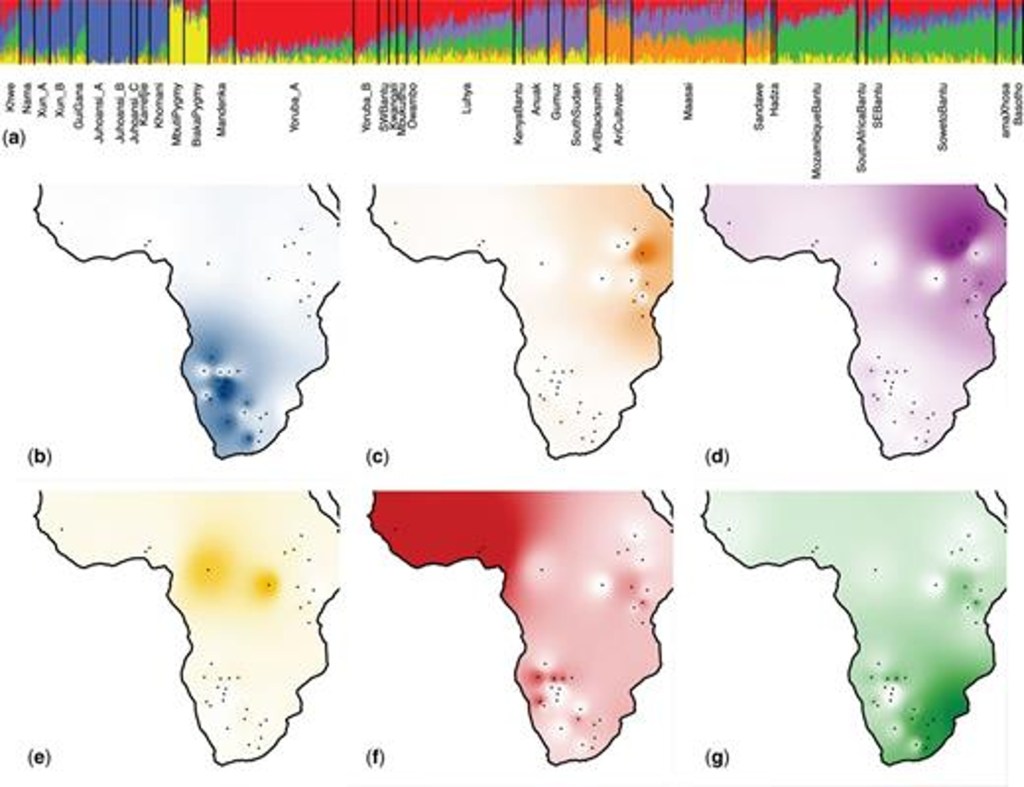
- Khoisan (in blue)
- Afroasiatic/Omotic (in orange)
- Nilotic (in purple)
- Pygmy-Central African hunter-gatherers (in yellow)
- Sudanian/West-African (in red)
- Southeast Bantu (in green)
The Southeast Bantu populations is best defined by ethnic groups such as as Bemba, Yao, Chewa, Makonde, Tonga, Chokwe, Venda inhabiting regions of Zambia, Mozambique, Malawi, Angola, Zimbabwe.
This publication demonstrates that genetically, southeastern Bantu populations represent a coherent specific group different from other genetic subgroups (Khoisan, Sudanians, Pygmy…).
Mozambican genetic variation provides new insights into the Bantu expansion. Armando Semo & al. 2019
This other study describes the genetic components present in African populations :
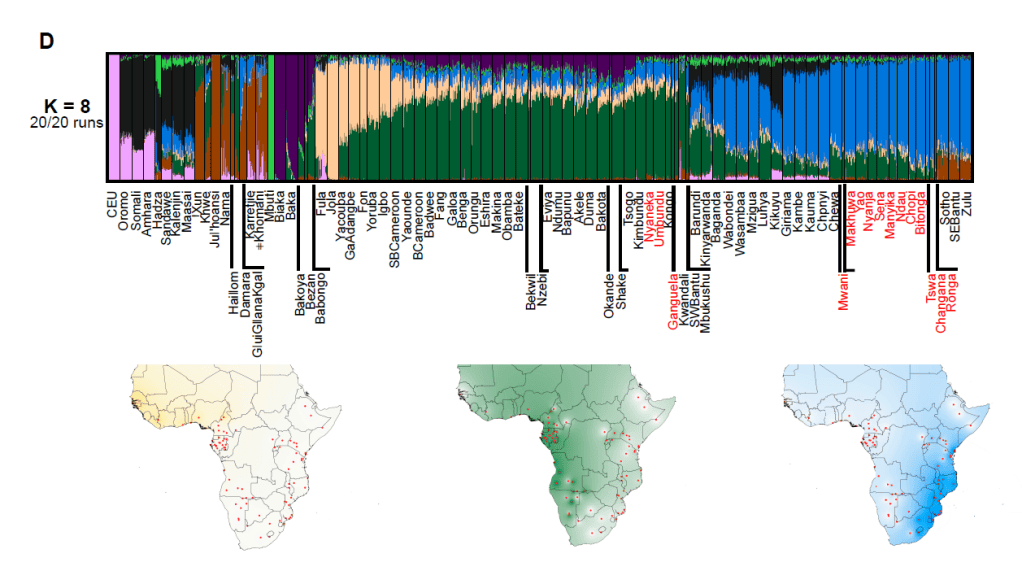
- A Sudanian component (in beige)
- A Central african component (in green)
- A Southeastern african component (in blue)
The Sudanian component peaks in West Africa, especially in groups such as Jola, Dan, Fon. The Central african component is concentrated in coastal Central Africa around Gabon and southern Cameroon, and is peaking among group like the Fang, Punu or Nzebi. The last one, the Southeastern african component is peaking among groups such as the Chewa, Makonde or Bemba in areas of Zambia, Mozambique, Zimbabwe or southern Tanzania.
This study indicates that there is a specific genetic non-Khoisan subgroup corresponding to Southeastern Bantu populations, which is different from West-African (Sudanian) and Central African (Western Bantu) populations.
Pygmy and Bantu populations share deep genetic connections :
Maternal traces of deep common ancestry and asymmetric gene flow between Pygmy hunter– gatherers and Bantu-speaking farmers. Quintana-Murci & al. 2007
This article describes the genetic relations between Pygmy and Bantu groups of Central Africa (Cameroon, Gabon, Equatorial Guinea, Republic of Congo).
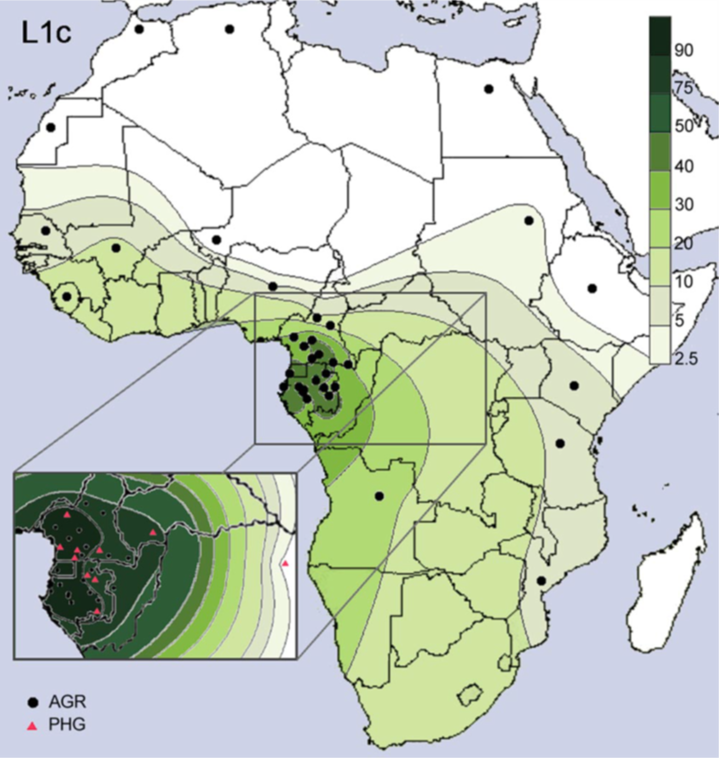
This study shows that hunter-gatherers groups (Baka, Babongo, Bakola…) and farmer populations (Fang, Ewondo, Punu…) descent from a common maternal ancestor living in the region about 70 000 year BCE, associated with the maternal haplogroup L1ca.
The publication also indicates that genetic flow occured between Pygmy hunter-gatherers and Bantu farmers groups starting 40 000 years ago up until now. The main difference between the groups being the Bantu farmer having integrated others clades from others groups (L0, L2, L3…). Moreover the haplogroup MtDNA L1C is highly concentrated in Gabon, Congo, Cameroon and along the Atlantic coast but is not spread in East, South-East and Southern Africa. It goes again a spread of Bantu populations to all of subequatorial Africa.
Current Southeastern Bantu populations possess very ancient maternal haplogroups distinct from Khoisan and Pygmies
60,000 years of interactions between Central and Eastern Africa documented by major African mitochondrial haplogroup L2. Silva, Alshamali & al. 2015.
This article discuss the genetics and haplogroups of differents African populations. It analyse the repartition of the main MtDNA haplogroups (L0, L1, L2, L3, L4, L5, M…) within different populations.
This research shows that L0 haplogroup, a very ancient haplogroup, is well represented among South and Southeast Bantu population (25%) and is different from haplogroup present in Khoisan population (L0a). On average, southeast Bantu groups are :
- 25% L0d
- 20% L1c
- 20% L2
- 30% L3
- 5% other haplogroups (L4, L5…)
Summary :
In conclusion, these genetic studies and articles tell us the following points :
- Clear genetic conclusions concerning the nature of Bantu migrations are currently premature, due to shortage of data as well of lack of comparability between them
- There is currently no Bantu-specific marker (Y-DNA, MtDNA, other genetic markers…) which could be linked to the Bantu expansion
- Southeastern Bantu populations (Bemba, Venda, Chewa, Makonde…) represent a coherent genetic group different from other genetic subgroups (Khoisan, Sudanians, Pygmy…).
- There is a specific genetic subgroup corresponding to Southeastern Bantu populations, which is distinct from West-African (Sudanian) and Central African (Western Bantu) and Khoisan populations
- Pygmy and Bantu populations are genetically related and had a common ancestor living in Africa 70 000 years ago.
- Spread of maternal haplogroup L1c -common to Pygmy and Bantu groups- is limited to Gabon, Cameroon and the Atlantic coast, which goes against a spread of Bantu population to all of Subequatorial Africa
- Southeastern Bantu population have a high pourcentage of very ancient maternal haplogroups (L0d, L1c… being over 50 000 years old) distinct from those from Khoisan and Pygmies groups, giving support for a presence in the region way before the proposed Bantu expansion.
We have seen that genetic evidence for a major Bantu migration is scarce and more genetic elements are supporting the hypothesis of an ancient presence of Bantu populations (more than 50 000 years BCE) in the subequatorial region. In the next chapter of this series, we will discuss the archaeology and material cultures to understand who is responsible for the ancient prehistoric cultures in the Bantu area ?

 Empire of Kitara
Leave a comment