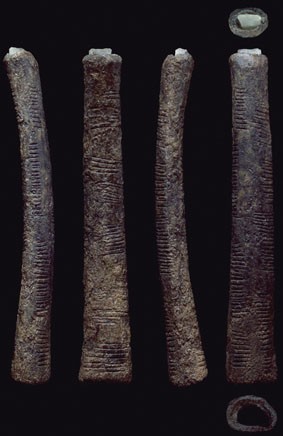
In this article, we will consider the material elements related to Bantu populations to see if it matches the Bantu expansion model, and we will investigate to understand who are the responsibles for these ancient cultures.
Sangoan industry :
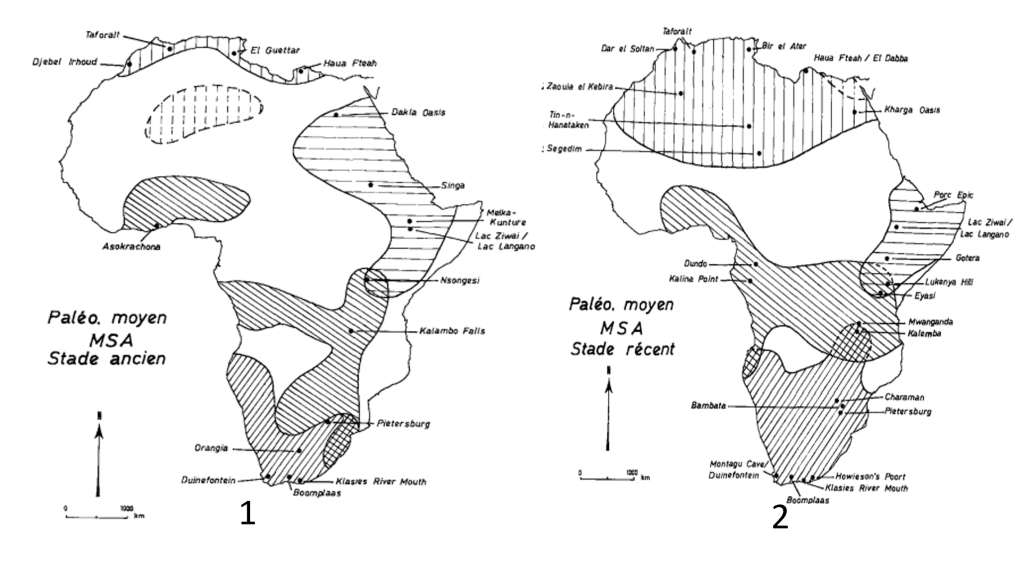
This is one of the first lithic industry of Subsaharan Africa, covering a time span between 500 000 BCE to 300 000 BCE. It covered large parts of Eastern and Central Africa with some extension into Southern and probably Northern Africa. This industry was characterized by heavy tools such as picks, axes or choppers.
Lupemban industry :
The Lupemban industry is believed to have succeeded the Sangoan industry, starting around 300 000 BCE and present up until 10 000 BCE. This prehistoric culture is distributed all over Central Africa, the Great Lakes region, the southern savannah between the Congo forest and the Zambezi river and some parts of Eastern and Southern Africa. Its tools are noticeable by their bi-facially flaked shape.
Nachikufan industry :
This industry was covering a large part of the southern savannahs (current Zambia, Angola, Malawi, DRC, Mozambique…) and was characterized by microlithic tools (axes, stone scrapers, grindstones…). It occured starting around 9000 BCE up into the last millennias before the common era.
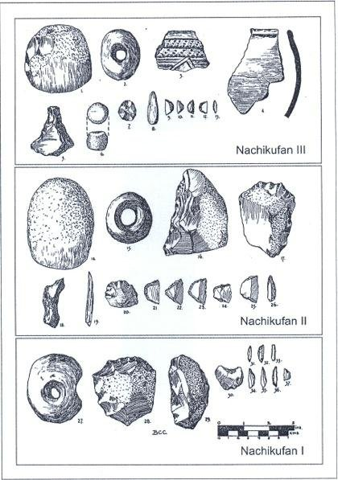
All these prehistoric cultures (Sangoan, Lupemban, Nachikufan) cover the current Bantu area of Central, Eastern and Southern Africa and are the testimony of a human presence and a material continuity from the Early Stone Age (500 000 BCE) to the Neolithic period (transition to the Common Era).
Rock art : the Schematic Rock art Zone
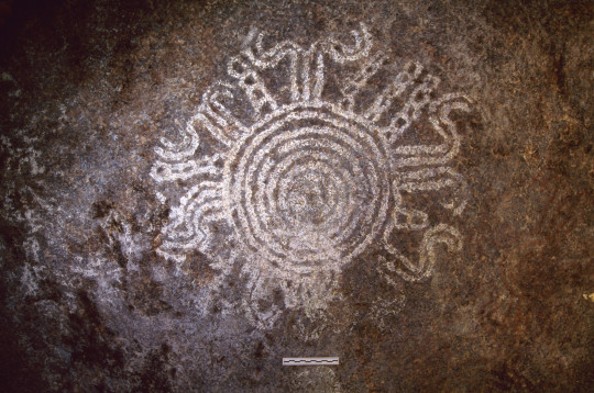
The area of Central and East Africa is covered by a distinctive prehistoric rock art tradition with geometrical design called the Schematic Zone Art (or Central African rock art). Around 3000 rock art sites are found in this zone (see distribution map below).
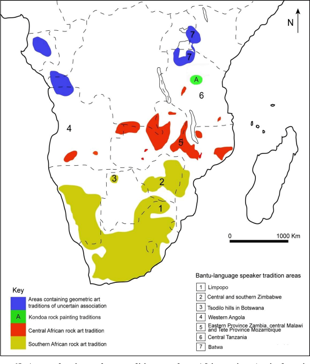
This tradition is characterized by circles, spirals, dots and lines. The motifs are predominantly painted in red or white, and are mostly finger-painted. These paintings were probably realized for religious purposes.
Archaeological sites :
Several archaeologic sites with elements of the different lithic cultures and rock art tradition mentionned, are to be found in the Bantu area :
- Matupi cave (Ituri region, DRC) : this site is occupied continuously since the Late Stone Age (40 000 BCE). Microlithics tools (axes, grind stones, stones scrapers) have been found on the site.
- Dimba Cave (Congo Republic) : these caves contain remains of lithic tools dating around 18 000 BCE
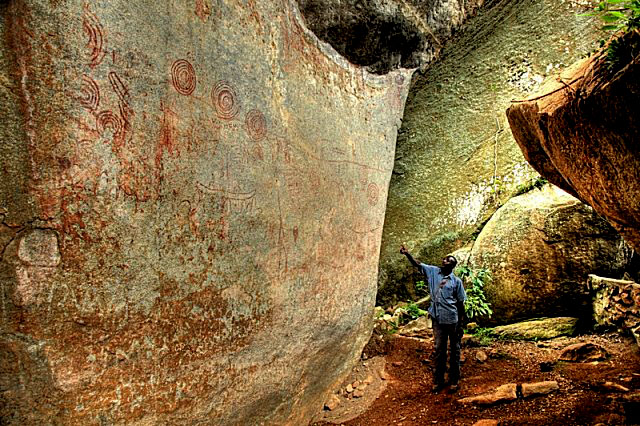
- Nyero cave (Eastern Uganda) : these set of caves contain an important series of rock paintings displaying schematic rock art (see picture below).
In conclusion, we see that archaeology and analysis of ancient material cultures demonstrate that since at least 100 000 BCE, there is a coherent material and cultural unity expressed by lithic industries, rock art and archaeological sites in the whole area of the southern savannahs. This area clearly overlaps the current area of Bantu languages, indicating a probable connection. The pre-Bantu population responsible for these material cultures were probably nomadic hunter-gatherers groups.
The next question is the identity of theses populations and their relations with current Bantu population. This will be the subject of the next article, who were the “pre-bantu” populations inhabiting the Bantu area and who are their descendants now ?


Leave a Reply