In this article, we are going to question the common assessment that Pygmies populations (also known as Twa or Abatwa) have lost their original language and adopted a Bantu language. And ask ourselves, what is the original Pygmy/Twa language ?
The Pygmies or Twa people are a group of population inhabiting Central African forests and distinguable from surrounding African populations by some specific caracteristics :
- A nomadic hunter-gatherer way of life
- An average height below the mean height of surrounding agrarian population
- An inferior socio-economic status, where they are usually considered as a inferior caste by other groups
Some example of Twa groups are :
- The Aka in Congo
- The Bakka in Congo, Cameroon and Gabon
- The Mbuti in North Eastern DRC
- The Great Lakes Twa in Uganda, Rwanda and Burundi
- The Bangwelu Batwa in Zambia
The languages spoken by the Twa belong to the following linguistic families :
- Bantu
- Ubangian
- Central Sudanic
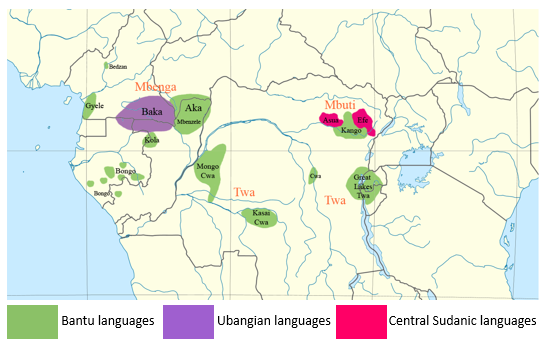
As shown in the map above, most of Twa populations (Aka, Mongo, Bongo, Great Lakes) speak a Bantu language, others like the Mbuti or Baka speak Ubangian or Central Sudanic language. The first noticeable element is that these groups speak the same language as their agrarian couterparts. Non-Twa neighbors of the Baka, the Mbuti or the Aka speak similar languages. There is no linguistic unity of the Twa people but linguistic affiliation with non-Twa ethnicities.
Moreover, there is no trace of a specific Twa language. Even if specific vocabulary for forest species and products have been found to be unique to Twa language and absent in other Bantu language, this is not a proof of a lost language but only the proof that these groups have develop specific words linked to their environment when other Bantu groups in other environment didn’t.
The Twa groups are known to have lived isolated in the Congo rainforests for thousands of years, prior to any potential Bantu migration. To find these groups speaking in majority Bantu languages, without any traces of another specific Twa language spoken in the past, and considering the absence of major Bantu contact (especially for nomadic groups isolated in the forest like the Aka), we are facing a linguistic enigma.
The picture is even more strange when we see others hunter-gathers groups in Africa like the Hadza or the San, less isolated than the Twa and who have been able to retain their original language (click languages). How the isolated Aka in the heart of the Congo rainforest do not have a specific Twa language when in the same time the Hadza, surrounded by Nilotic, Bantu and Cushitic groups have retain their click language ?
We can summarize the Twa language enigma in few points :
- Twa people are characterized by their hunting and gathering way of life, physical difference (short stature) and low caste status
- Twa people have lived isolated in the Congo rainforest for dozens of thousands of years
- Twa people are mainly speaking Bantu language
- Their languages are similar to their non-Twa neighbors
- There is no trace of a Twa linguistic family or original language
This linguistic enigma leave only one logical answer, which is the most simple : the Twa people never lost their language and the current “Bantu” language they spoke is their original language.
If we consider the hypothesis of Bantu language being the original language of Twa groups in Central Africa, then we can understand their close relations with agrarian groups.
This hypothesis leads to another conclusion : Bantu languages are not a “recent” linguistic family originating from Mount Cameroon about 5000 years ago, but a ancient linguistic family which was spoken dozens of thousands of years ago in Central Africa by the common ancestor of Twa and Bantu people.
In conclusion, we have seen in this article that the common theory stating that Pygmy/Twa people haved lost their original language and adopted the Bantu language doesn’t hold water under scrutiny, and the Bantu language is the original language of Twa people.
In the next article of this series, we will analyse why there is no Bantu languages north of the Equatorial forest ?


Leave a Reply