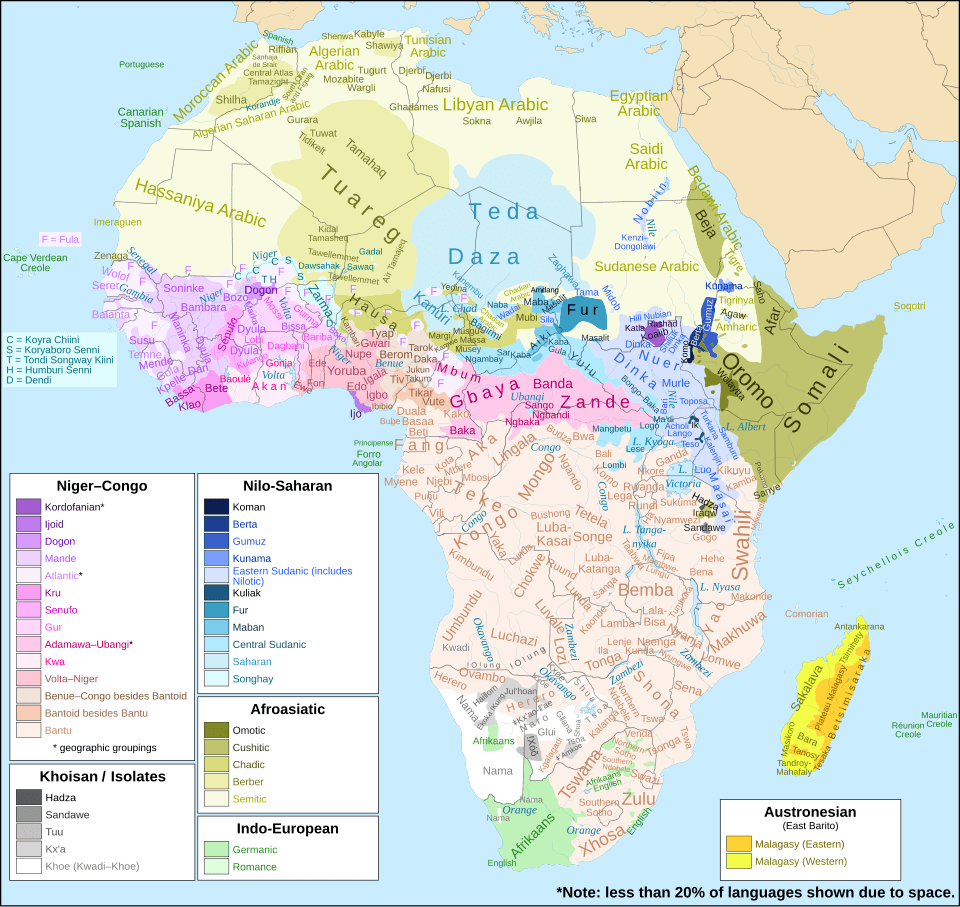
According to the Bantu expansion model, Bantu people spread from Mount Cameroon area towards sub-equatorial Africa. However, once this point stated, a question arises : Why is there virtually no Bantu languages north of the Equatorial forest ?
When we look at the linguistic map of Africa, the Bantu languages are concentrated in Central, Eastern and Southern Africa, and only few Bantu (mostly Semi-Bantu) languages are found north of the EquatoriaL forest (mainly in Cameroon), this seems counter-intuitive with the cradle of Bantu languages located north of the forest around the Mount Cameroon.
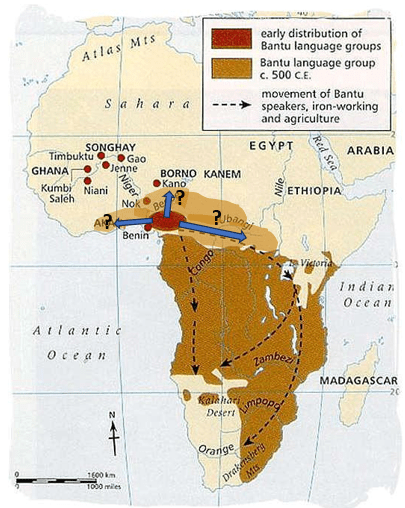
If we analyse human migrations, the dispersal of languages from a cradleland is more likely to have taken place in all directions rather than only one direction. Hence, the unidirectional nature of the Bantu migration is quite unusual.
Here is an excerpt of the languages families present in the regions surrounding the proposed Bantu homeland.
| Region | Language family |
| Bantu homeland : Mount Cameroon area | Semi Bantu |
| Coastal West Africa | Kwa languages : Igbo, Yoruba, Fon, Ewe, Akan |
| Lake Tchad area | Chadic and Nilo-Saharan |
| Central African Republic | Ubanguian |
| Subequatorial Africa | Bantu |
If Bantu languages have spread from the Mount Cameroon area, the linguistic repartition would probably have been the following :
| Region | Language |
| Bantu homeland : Mount Cameroon area | Bantu |
| Coastal West Africa | Bantu |
| Lake Tchad area | Bantu |
| Central African Republic | Bantu |
| Subequatorial Africa | Bantu |
If we take a look at a physical map of Africa, we found that the Bantu proposed homeland is an open region with no major physical barrier (desert, forest, marshlands, mountain range… except in the south with the equatorial forest !) preventing populations to move in other directions. We should easily find traces of Bantu groups in the area.
One can also notice the absence of Bantu language in the Central African Republic area, north of the Equatorial Forest, in the region supposed to have been crossed by the Bantu migrants moving towards the Great Lakes (as per Early Split hypothesis). If Bantu agrarian groups have lived in this area, we should have trace of their presence.
A natural spread of Bantu people would have created a large span of Bantu group from potentially current west of Ghana to the East of Central African Republic and covering the whole of Nigeria and parts of Chad. Even if we consider the hypothese of posterior migrations changing the linguistic map of Africa, we would have still found a presence of ancient bantu languages in the pre-cited regions.
A comparison of the Bantu and Indo-European expansion maps highlights the fragility of the Bantu migration model, while the Indo-European model have more supporting evidence (geography, archaeology) as desribed in the table below :
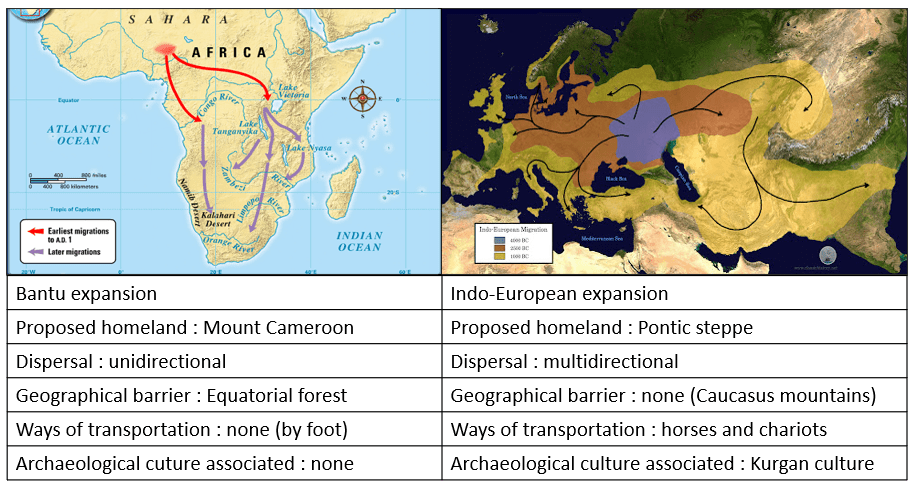
In summary, we see here that the absence of Bantu language in West African regions surrounding the Bantu proposed homeland (Mount Cameroon area) makes the spread of Bantu languages hardly understandable in terms of human movements and questions the validity of the proposed cradle of Bantu populations around the Mount Cameroon. If there is no Bantu language north of the equatorial forest, it might be because the true Bantu homeland is not north of the Equatorial forest.
In the next article of this series, we’ll enter the linguistic field and verify where in Africa are found the most archaic and conservative Bantu languages ? This question will orient us to another region of the continent.


Leave a Reply