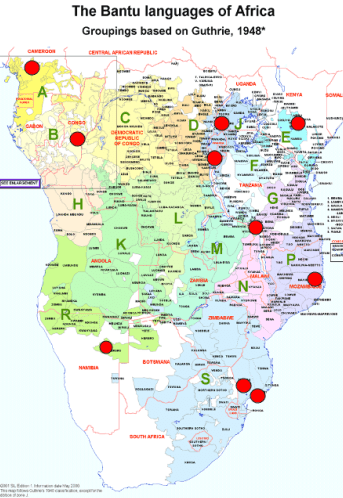
The classical Bantu theory present the homeland of Bantu populations as the area of Mount Cameroon – Nigeria-Cameroon border. This place is supposed to be the home of most archaic Bantu languages (the “Proto-Bantu” language).
This proposal of the Mount Cameroon as the place of origin of Bantu languages is based on the works of the American linguist Joseph Greenberg, who based his theory on a mass comparison of words between languages. His mass comparison analysis leads him to the conclusion that the most probable place of origin of Bantu languages resides around the Mount Cameroon (or Nigeria-Cameroon border). However his method is very problematic from a linguistic viewpoint. Indeed, languages follow specific rules (phonetic laws, sound shifts, tones…) which have to be taken into account in linguistic comparison, and Grennberg’s method didn’t. As highlighted by the linguist Jan Knappert, if we follow Greenberg method of mass word comparison, English would be classified as a Romance language instead of a Germanic, and Swahili would be Semitic instead of Bantu ! As we see here, the Greenberg method presents critical flaws which raises questions on the hypothesis of the Mount Cameroon area of origin for Bantu languages.
The Bantu languages present specific characteristic, among them :
- A noun-class system (about 20 classes, with singular and plural classes)
- A syntax with Subject-Verb-Object (SVO) order
- A phonetic structure of Consonant-Vowel-Consonant-Vowel (CVCV)
- The use of prefixes to define the noun class (mu-, ba-, mi-, bi-…)
Among the Bantu family, some languages possess all these characteristics to the greatest extent, some only partially. The former are considerer to be the more archaic or classical Bantu languages (closed to the proto-Bantu), the others are considered more recent and probablly mixed or influenced by other non-Bantu languages. A linguistic map had been proposed by the British explorer and linguist Harry Johnston in the beginning of the XXth century to illustrate the repartition of Bantu languages in function of their closeness to the proto-Bantu, considered as the ancestor of the family (see image below).
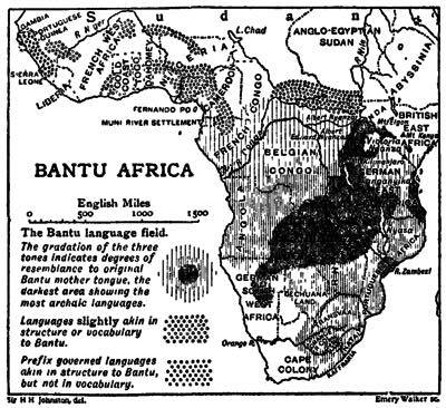
This linguistic map shows that the most archaic languages are located in an losange-shaped area spreading from the Great Lakes region to the Namib region, with a center in the Katanga plateau.
Another linguistic analysis had been conducted by Malcolm Guthrie, a renowned African linguist working in the Congo region in the 1950-1960s. According to him, the lexical comparison (conducted according to linguistic rules !) indicates that the highest number of common morphems (the root of the word) for the Bantu family is found in the Katanga plateau (also known as Shaba) between the sources of the Congo and Zambezi river, as can be seen in the map below :
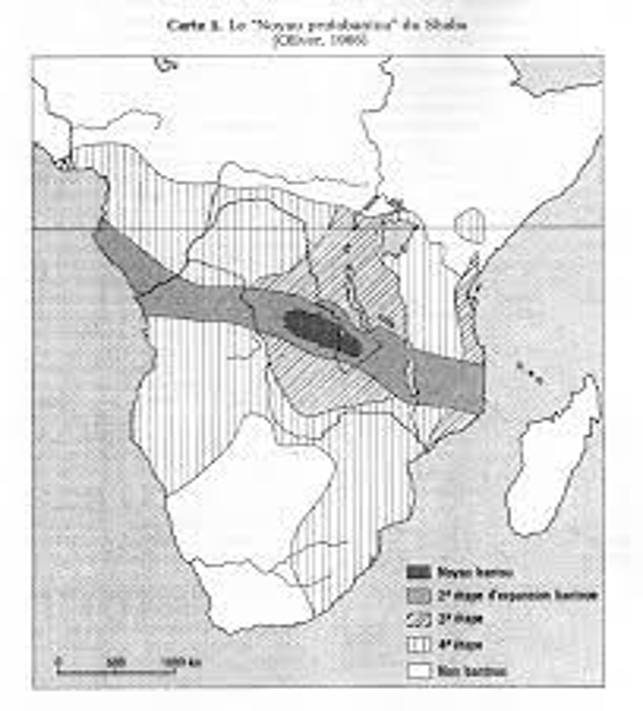
These two maps from Johnston and Guthrie completely overlap and highlight the same area : the Katanga plateau, as the region of most archaic languages and so the most place of origin of the Proto-Bantu.
In conclusion, the Greenberg theory of proto-Bantu originating around Mount Cameroon doesn’t hold water as his linguistic study had been done without considering basic linguistic rules, leading to biaised results. On the contrary, Johnston and Guthrie works based on the analysis of Bantu languages and considering linguistic characteristics (noun-class system, phonetic structures common morphems) indicate a more realistic place of origin of Bantu languages in the Katanga plateau, around the source of the Congo river.
We now have a new place of origin for Bantu languages, south of the equatorial forest, at the heart of the Bantu region, in the Katanga. In the next chapter, we are going to see : What did oral tradition tell us about the Bantu migration and why there is no great migration story among most of Bantu people ?


Leave a Reply