
The Bantu theory states that thousands of years ago, some African groups started one of the greatest migration ever from a tiny place around Mount Cameroon to populate half of the African continent. Is this theory supported by oral tradition ?
If we analyse the oral tradition and oral litterature (royal genealogies, royal rituals, epics kept and known by heart by specialists) of some of the larger Bantu ethnicities, we found that each of these groups have a mythical place of origin :
| Ethnicity | Country | Place of origin according to oral tradition |
| Baganda | Uganda | Mount Elgon (Uganda/Kenya border) |
| Banyarwanda | Rwanda | Ikinani rock (Eastern Rwanda) |
| Kikuyu | Kenya | Mount Kenya |
| Zulu | South Africa | Uhlanga (Great Lakes of East Africa) |
| Chewa | Malawi | Mount Kaphiri-Ntiwa (Mozambique) |
| Makonde | Mozambique, Tanzanie | Ruvuma river (Mozambique) |
| Karanga | Zimbabwe | Guruuswa (East Africa) |
The geographical locations of all this places can be seen below :
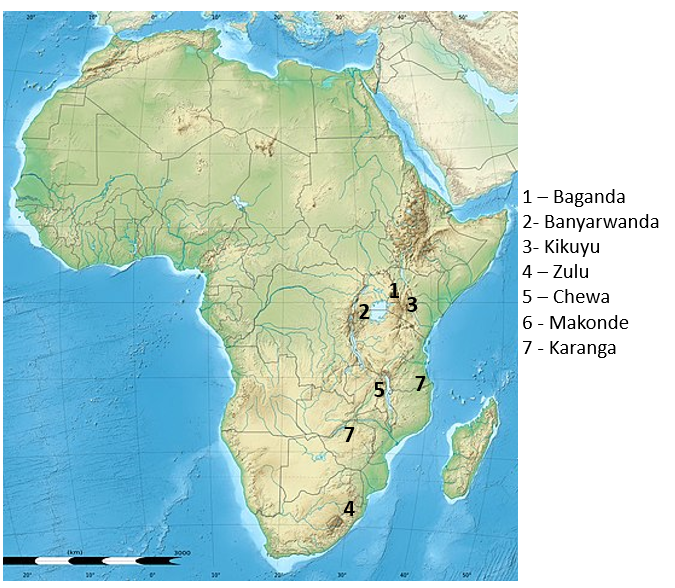
Most of these groups claims to be “children of the soil”, meaning autochtonous to their current place, although some (Zulu, Karanga) recall a migration from another place, usually in the North of their current habitation, but none of them mention any great migration across or around the Equatorial forest, and their places of origin are not matching at all the Mount Cameroon region, presented as the Bantu place of origin. If some migrations occured (as everywhere in the world), then it as most ususally local or regional migrations (limited in time and space).
If the Bantu have migrated from Mount Cameroon by passing (or contourning) the Congo forest, this event would mostly have been present even partially in their oral tradition in the form of a great migration story, in the same vein as the Exodus among the Hebrews or the Great Trek among the Afrikaners. We can imagine a set of traditions mentionning the start and the cause of the great migration (desertification, famine, war, ethnic conflict, religious call), the challenges of the journey (crossing the forest, illness, fight with tribes, alliances and divisions, means to cross the main rivers, deaths of the leaders…), the differents stages of the journey, the end of the migrations (the arrival in the new country, encounter with the inhabitants).
None of the Bantu groups mentionned above possess this kind of migration story but instead they have a set of tradition claiming an autochtonous origin or for some an origin in East Africa around the Great Lakes. This absence of a great migration story can be explained by 2 solutions :
- The Bantu groups have forgotten their migration story
- The Bantu groups have never migrated
As seen above, these groups possess a rich oral tradition and oral litterature which mentionned their ancestors, place of origin, main past events. If they have been able to maintain their ethnic history for so long, it seems unlogical that they forget their migration story, so we can then leave out the first solution. The only solution remaining is that this absence of great migration story is a proof that the Bantu groups never migrated from the north of Equatorial Forest and have always lived in the regions they are now.
In conclusion, the oral histories of most of Bantu groups never talk about a great migration from Mount Cameroon towards all of subequatorial Africa. Instead these populations usually presents themselves as indigenous to the land they currently inhabit. This absence of a great migration story is an additional argument against the mainstream Bantu theory.
In the next chapter, we will start investigating the relation between Bantu and other ethnic groups of Central, Eastern and Southern Africa and ask ourselves How did the Bantu allegedly dominate other powerful groups such as Nilotes and Cushites ?


Leave a Reply