
According to the Bantu expansion theory, when Bantu groups arrive in East Africa, they encountered other groups such as Nilotes, Cushites or Central Sudanic populations. How did they managed to get the upper hand on these powerful groups ?
Around 500 BCE, East Africa was supposedly populated by several groups :
- Southern Cushitic, inhabiting most part of Kenya, and northern Tanzania
- Southern Nilotics, present in eastern Uganda, central and western Kenya,
- Central Sudanics, inhabiting northwest Uganda and northeastern DRC
- Hadza & Sandawe, occupying northern and central Tanzania
These populations, especially Cushitic, Southern Nilotics and Central Sudanics practiced agriculture, pastoralism, have several traditions of pottery and among them some tribes have started to initiate metallurgy, proto-urban settlements and trade with other continents (India, Arabia…).
According to the Bantu theory, Bantu groups arriving in this area around 500 BCE, managed to impose their language and culture over these different groups, leading to the current situation, where a vast majority of East Africa is inhabited by Bantu speakers, except for some parts of Uganda, Kenya and Tanzania.
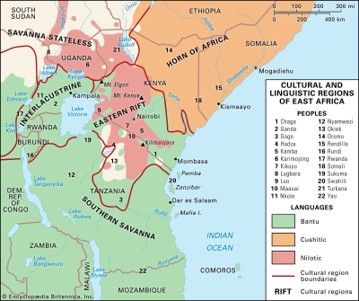
However when looking at East African history we see that groups such as the Nilotes (Maasai, Kalenjin, Luo) or Cushites (Oromo, Somali) have always maintained a strong martial tradition (linked to the need to protect their cattle) and when in contact with Bantu groups (Kikuyu, Luyha, Mijikenda…) have kept the upper hand in terms of political domination and land control. In comparison to Nilotes and Cushites which are usually nomadic and pastoralist with a patrilineal structure, Bantu groups such as Sukuma, Chagga or Kamba are more prone to a sedentary and agrarian way of life with a tendancy to matrilineal kinship. All these elements put away the idea of a Bantu conquest over Nilotes, Cushites or Central Sudanians.
Even in terms of demographics, archaeology have demonstrated that the Rift Valley was home to several neolithic cultures and these cultures have profoundly impacted the region. We can mentionned some here such as :
- Savannah Pastoral Neolithic, linked to Southern Cushitic groups, this culture initiated dry stone construction, pastoralism and irrigation and was present over a large part of Central Highlands in current Kenya.
- Elmenteitan, probably established by proto-Southern Nilotics around Lake Turkana and northern Kenya, with stone cairns, pastoralism and fishing.
- Kansyore culture, linked to Nilo-Saharans groups living through fishing around lakes and rivers, producing the oldest ceramics in the region (7000 BCE), and present in the Great Lakes region.
These cultures, thriving during millenias and spanning over large areas might have implied a certain demographic, in addition to a noticeable cultural influence on populations. The idea of Bantu populations assimilating these numerous and major groups and achieving to impose their language other them seems shaky, especially when we consider new archeologic elements indicates that Bantu groups did not originally have knowledge of iron and received it from these groups (from Central Sudanic in particular).
If Bantu groups have not dominated the already present groups and didn’t influence or assimilate then culturally, how come Bantu groups are so overwhelminlgy present in East Africa.
The easiest solution to this problem is to consider that the Bantu are an indigenous group of East Africa, and that they never arrived from somewhere else. If the Bantu are indigenous to East Africa and the regions they occupied now (Great Lakes, Indian Ocean coast, western Kenya, southern Tanzania…), then their current important presence in the region is easily understood.
With this hypothesis, the Bantu never invaded East Africa and have always be present in the region, coexisting with the others groups Nilotes, Cushitic, Central Sudanians, Hadza & Sandawe… which all seems also to be indigenous to some parts of the East African region).
Finally, our analysis instead of seeing the Bantu as newcomers from Mount Cameroon who dominating pre-existing populations, proposed that the Bantu have always inhabited some parts of East Africa, and co-exist, interact, married, live with other groups present.
In the next article of our series, we will investigate why there is no isolate language in most of Bantu area ?


Leave a Reply