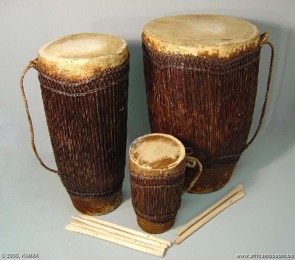
When we study African societies, we found drums among many of them : Ceremonial drums, war drums, communication drums… In Kitara, the drum is more than a musical instrument, it’s a sacred symbol.
For the peoples of the region, the Universe is a total, spiritual reality in which everything is in motion. All elements of Nature—including Human Beings—participate together in the cosmic movement. From the vibration of electrons to the movement of galaxies, the Universe is a cosmic hymn, a universal dance animated by the divine.
Since the Universe is a dance, the Ancestors established rituals that reproduce the dance of the elements through sacred dances. In Central Africa, these dances are among the most vibrant expressions of traditional spirituality, and the central element of these celebrations is an instrument: the drum, known locally as the Ngoma. By extension, the term Ngoma also came to refer to all dances and celebrations—songs, music, festivals, and arts—animated by the drum.
The drum produces a primordial vibration that initiates the dance, much like the primordial vibration AUM of the Vedas, the mirror of the first wave that radiated throughout the Universe. Like a resonator, it causes cosmic energy to radiate in all directions. It harmonizes spiritual energies, drives away evil spirits, heals illnesses, and amplifies vital energy.
The Ngoma is considered a living being. It has a body: people speak of the belly of the drum, its waist, its navel, its breasts (yes, the drum is often regarded as feminine), its forehead, and even the heart of the drum, which contains a secret object. The making of the drum itself follows a sacred protocol carried out by a hereditary guild of ritual specialists. Made from the trunk of a sacred tree, the drum is carved and then covered with an animal-skin membrane. Before the object is completed, a sacred and secret element is placed inside it, giving the drum its spiritual power.
The Ngoma runs throughout the entire history of Kitara and Africa, from its origins to the present day. It appears in the origin myth of the Bayira of the Congo, in which the first human couple resides inside a drum; and also in the myth of Ntare, an ancient hero who founded the Kingdom of Burundi and created the first drum of the country.
Drums are found at every level of society: in royalty, among clans, in religious ceremonies, at festivals, and so forth. They also spread beyond Africa and can be found at the heart of Afro-Caribbean religious traditions such as Candomblé, Santería, and Vodun, as well as Gnawa and Zar in North Africa, and more recently in Capoeira and Hip-Hop. All these cultural expressions can be regarded as Ngoma ceremonies, in which the drum occupies a central place. Thus, from Kitara to the Bwa Kayman ceremony that launched the Haitian Revolution, from Hip-Hop to Rastafari, it is the Ngoma that we find: the celebration of the dance of the Universe.
In Kitara, the most important drums are known as Ingabe (“power”) and are the objects of particular veneration. A true Ark of the Covenant, each kingdom of Kitara possessed one. The Ngoma was the spiritual symbol of the nation and contained the soul of the kingdom.
Thus, each sacred drum had its own name: it was called Karinga in Rwanda, Karyenda in Burundi, and Timba in Buganda.
The drum was therefore a true royal personage:
- It was enthroned and sanctified during its making.
- It had its own palace, where it was kept under the care of a priestess, known as the Drum’s wife.
- It was accompanied by smaller secondary drums used for accompaniment.
- It was carried in a palanquin and was never allowed to touch the ground.
- It was flanked by a spear and a shield for protection.
- It was covered with bark-cloth garments to conceal it from the eyes of the uninitiated.
- It was regularly maintained with ointments and butters to preserve the quality of the wood.
- Specific dances were performed in the royal courts in honor of the Drum.
- It was used to announce major events in the Kingdom.
The Ngoma was therefore at the very heart of society. It was simultaneously an object, a ceremony, and a symbol of the kingdom, and the term even came to designate the reign of the sacred king, the Mwami, who was the ultimate protector of the Drum.
As we see here, more than an instrument, the Ngoma is in Kitara a major spiritual symbol. Kitara is thus the civilization of the Ngoma.
It’s commonly said that Africa is the land of rythm, it would be more exact to say that Africa is the land of the Ngoma.
 Empire of Kitara
Leave a comment