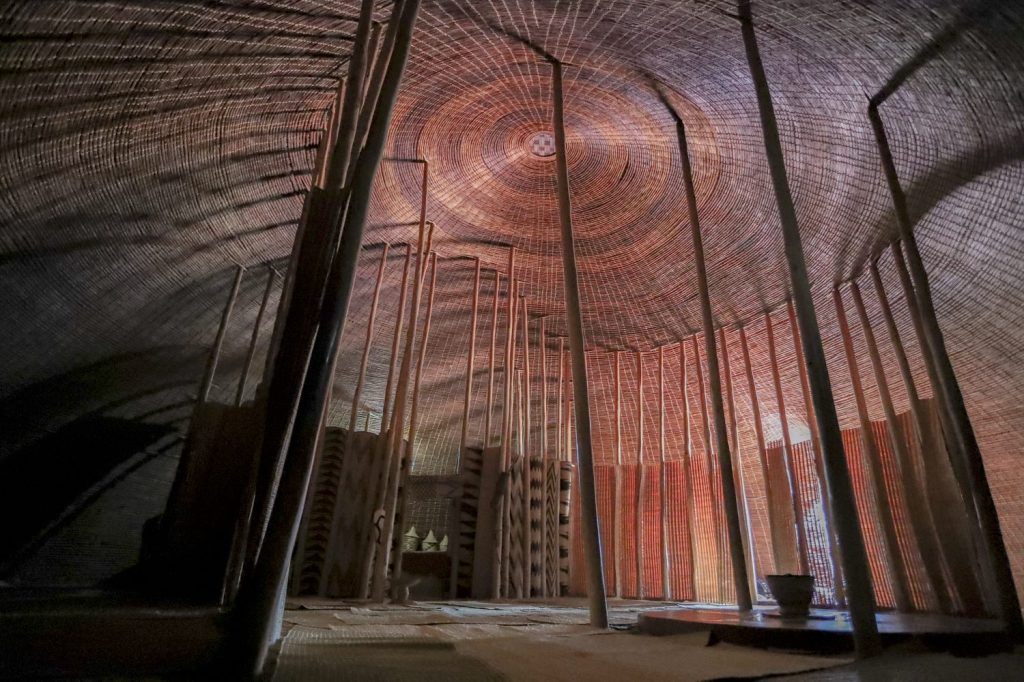
The Great Lakes region, by the end of the 19th century, comprised a large number of kingdoms headed by powerful kings. Generally bearing the titles Mwami, Mukama, Mugabe, or Kabaka, these men were not merely war chiefs or figures of authority, but sacred kings. Throughout the region, one finds the same general model, with local variations: sacred kingship, also known as Ubwami.
The principal title used for these kings is Mwami, which is said to derive from the verb kwama in the local language, meaning “to make fruitful” or “to bring to life.” Mwami could therefore be translated as “the source of life.” In Bunyoro (western Uganda), the title Mukama is used, which can be translated as “the shepherd of the people.” In Nkore (in present-day southern Uganda), he is called Omugabe, meaning “the Commander of the Nation.”
The Mwami belongs to the royal clan and is the son of the previous Mwami by a royal wife, who herself belongs to a clan chosen beforehand.
At birth, the future king is said to be “born with seeds in his hand,” a traditional expression referring to the ritualists’ use of divination to determine whether the child bears favorable signs for his future role. The future heir then grows up as a prince at court, where he receives a comprehensive education: weapons, hunting, politics, oratory, poetry, law, history, customs, and more.
Upon the death of the reigning Mwami, the new Mwami is enthroned. He undergoes an enthronement ritual conducted by royal priests known as the Abiru: ritual bathing, initiation into the traditions, receiving the royal insignia, being presented to the people and acclaimed by the crowd, entering the royal hut, and so forth.
The Mwami then receives a new name. This royal name is both a program and a philosophical message defining the purpose of his reign:
Thus, throughout the region, one finds names such as Mwezi (“the Moon”), Ntare (“the Lion”), Mwambutsa (“the One Who Crosses Rivers”), Yuhi (“the King of Fire”), Ruganzu (“the Conqueror”), Nkuba (“the Thunder”), and Kimenyi (“the Wise One” or “the Learned One”)… The name indicates whether the reign will be peaceful or expansionist, focused on the spiritual or the material, long-lasting or short-lived. These names recur cyclically every three or four reigns, creating a link between kings bearing the same title across generations. Through these cyclical and philosophical names, the kingdom pursues a form of spiritual elevation through time and space.
Beside the King sits the Queen Mother, the second-ranking figure in the kingdom. She plays a major role during the regency when the king is still young, holds a recognized advisory position, and supports the Mwami in certain ceremonies. Indeed, in order to preserve the balance of the natural order, the king’s masculine and authoritative power must be balanced by a feminine and maternal pole embodied by the Queen Mother. Thus, it is a Mother-Son pair that governs the kingdom. The rest of the Mwami’s entourage consisted of the royal wives, who would provide the heir, ritualists, and numerous ministers, advisers, and royal servants.
During his reign, the Mwami fulfills the following roles and functions:
- He is the guardian of the Ngoma—the Drum, the sacred symbol of the Kingdom.
- Each year, he presides over the Great First Fruits Festival, known as Umuganuro, Umuganura, or Ndolegwa ya Mpeshi, depending on the kingdom and region. This is a national festival celebrating the prosperity and unity of the kingdom.
- He spiritually leads wars, and sometimes physically as well, in the case of kings whose royal names have a martial character.
- He is the supreme Judge and Legislator, settling disputes, holding public audiences, and promulgating the decrees and laws of the kingdom.
- He is the Master of the country’s wealth: land, cattle, and agricultural produce, which he redistributes among the people.
- He is the master of the arts, knowledge, and techniques: agriculture, livestock raising, hunting, ironworking, art, dance, poetry, and more.
- He is the most sacred and pure person in the kingdom. He cannot be seen eating, he cannot be touched, what he eats must be pure and sacred, and he cannot perform certain gestures or assume certain postures.
- He is the moral model of society, embodying and promoting its highest values: Strength, Wisdom, Goodness, Justice, and Truth.
Upon the death of the Mwami, society comes to a halt, and a period of national mourning begins, lasting several months. Activities, social life, and economic exchanges are suspended because, in the absence of the King, the country is regarded as vulnerable to negative forces. The suspension of activities is intended to limit the negative effects of this period. Life resumes upon the enthronement of the new Mwami.
The sovereign’s body is not buried in the same manner as that of the rest of the population. His body, still “warm” with the forces and energies of which he was the vessel, must be cooled and returned to a natural energetic state before being buried, lest it bring chaos and disrupt the reign of the new Mwami. The ritualists, the Abiru, place the royal remains in a hut, where a slow process of mummification through smoking takes place over several months. Once his body has cooled, he is buried in a sacred grove, and a tree—often a ficus—is planted where his body rests. The spirit of the Mwami then joins the realm of the royal ancestors—the otherworld of the Bami of the past—who are venerated through a royal court cult. However, the ritualists teach that on Earth, the spirit of the king remains ever-present in the form of a panther, a python, or a lion passing near the sacred grove.
In the kingdoms of Kitara, the King was therefore the central figure. More than a man, the Mwami was, for his kingdom, a crossroads-being, a point of cosmic balance between the natural and spiritual forces of the Universe: humans, animals, plants, minerals, rivers, mountains, ancestors, spirits, and so forth. To fulfill this unique role, his life—from his enthronement to his departure—was entirely ritualized, filled with prescriptions and prohibitions, in order to maintain harmony and prosperity within his kingdom.
The Kitara was perceived by its inhabitants as a kingdom where cosmic harmony ruled, and where the Mwami was the bridge between Heaven and Earth. During his reign, the kingdom lives in the divine presence, when he disapears, the kingdom become a simple human kingdom again.


Leave a Reply