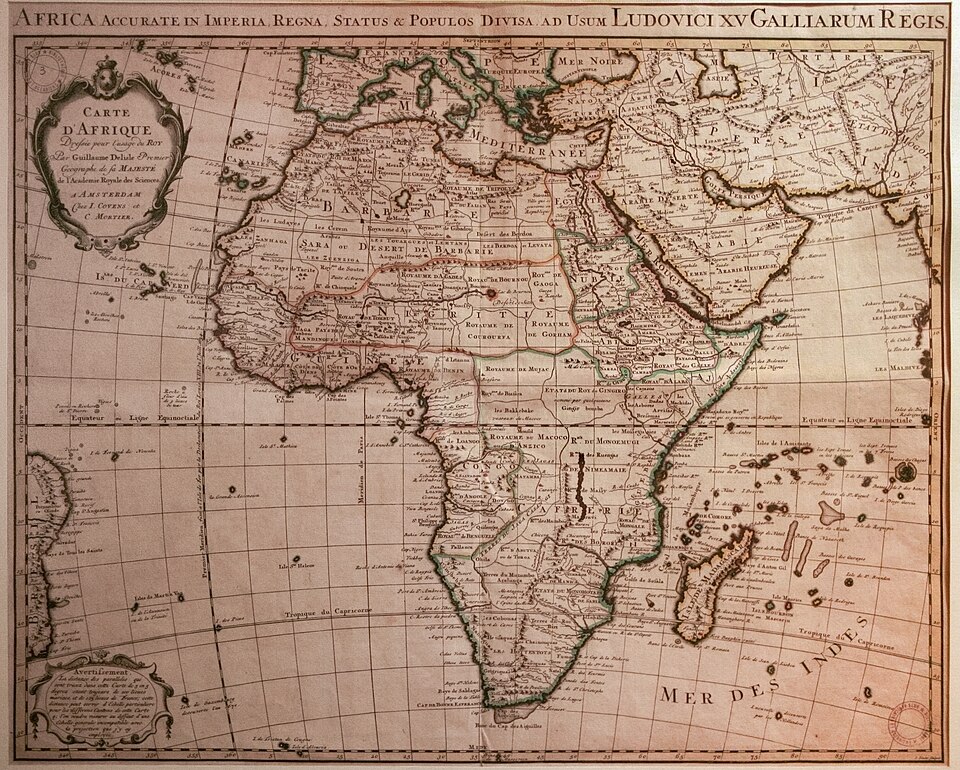
When we study the history of East Africa, several legends and testimonies recall an important kingdom which has existed in the interior of the continent several centuries ago, and goes by the name « Monemugi » or « Kingdom of the Zanj ». Are these testimonies only myths or is there some historical reality behing the legend of Monemugi ?
The Zanj Empire of Arabic sources :
The Kingdom of the Zanj, in the Arabic sources : Around 943 CE, the geographer Al Masudi in his book, the Meadows of Gold (Murūj aḏ-Ḏahab wa-Maʿādin al-Jawhar)[1], describes the Zanj (or Zenj) people of East Africa and their political structure :
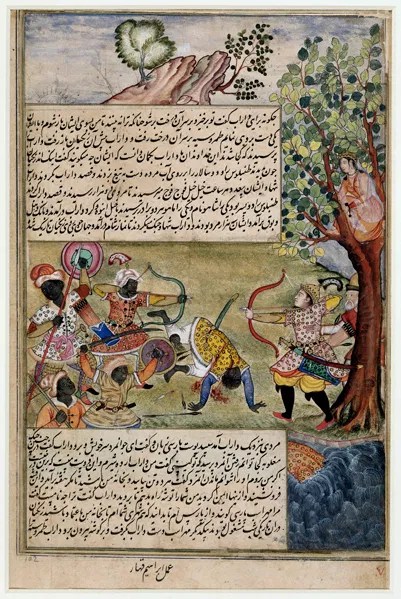
“The Zinj , with other Abyssinian tribes spread themselves to the right of the Nile, down to the extremity of the Sea of Abyssinia. Of all the Abyssinian (Ahabish) tribes the Zinj were the only ones who had crossed a tributary of the Nile (the Jubb (40)) which flowed into a bay or canal, which in turn opened into the Indian Ocean. Only the Zendjs cross the arm that splits of from the upper Nile, and throws itself in the sea that wears the name of those people, they fix themselves on the beaches, and extend their homes up to Sofala, which is the limit of their land. Their country goes down as far as the country of Sofala and the Waqwaq. There is the furthest limit for the voyages from Oman and Siraf on the Sea of the Zanj. In the same way that the sea of china ends with the lands of Sirla (Japan), the sea of Zanj ends with the land of Sofala and the Waq-waq, which produces gold and many other wonderful things. It has a wonderful climate and is fertile.
It is there that the Zanj build their capital (dar mamlaka): then they elected whom they called Waklimi (or Flimi) (or Ouaqlimi)(59) (the word means son of the supreme Lord “ibn er-Rabb el-Kebir”). This name… has always been that of their sovereigns. The Waklimi has under him all the other Zanj kings, and commands three hundred thousand men. The Zanj use the ox (80) as a beast of burden, for their country has no horses or mules or camels and they do not even know these animals. Snow and hail are unknown to them as to all Abyssinians. Some of their tribes have sharpened teeth and are cannibals. The land of Zanj begins with a branch which leaves the upper Nile and continues to the land of Sofala and the waqwaq. Their settlements extend over an area of about 700 parasangs (12) in length and in breath; this country is divided by valleys, mountains and stony deserts. Elephants are extremely common in the land of the Zinj; but they are wild and none are kept in captivity. The natives do not employ them in warfare nor for any other purpose, but they hunt them merely to kill them. When they want to catch them, they throw in the water the leaves, bark and branches of a certain tree which grows in their country: then they wait in ambush until the elephant comes to drink. The water makes them drunk and sick. They fall down and can not get up: their limbs will not move anymore. The Zanj rush upon them, armed with very long spears and kill them for their ivory.
Now let us return to our subject of the beginning of the chapter, the Zanj, the description of their country and of the other people of Abyssinia. The Zanj, although always busied hunting the elephant and collecting its ivory, make no use of it for domestic purposes. The zanj use iron for ornament instead of gold and silver just as they use oxen (80), as we said previously to carry loads as well as for war, instead of camels and horses.
To come back to the Zanj of Sofala and their kings, the name of the king of the country is Waklimi which means supreme lord; they give this title to their sovereign because he has been chosen to govern them justly. If he becomes tyrannical or strayed from the truth he is killed and his seed excluded from the throne for ever, for they claim that in thus conducting himself he ceases to be the son of the Master, that is to say of the king of heaven and earth. They call God by the name of Maklandjalu (58), which means supreme Master (er-rabb el-kebir)
The Zanj speak elegantly, and they have orators in their own language. Often a ascetic (zahid) man of the country, will get up and address a large crowd exhorting them to draw near to their god and render him obedience; frightening them with his punishment and authority, recalling them to the example of their former kings and ancestors (60). They have no revealed law to turn to but the customs of their kings.
The Zanj eat bananas, which are as abundant with them as in India, but the basis of their food is dhurra (sorghum), a plant called al-kalari (jams) which they take from the ground like a truffle. It is plentiful in Aden and the neighboring part of Yemen near to the town. It is like the cucumber of Egypt and Syria. They also have honey and meat. Each worships what he pleases, a plant, an animal, a mineral. They possess a great number of islands where the coconut grows, a fruit that is eaten by all the peoples of the Zanj. One of these islands, placed one or two days’ journey from the coast , has inhabitants who are Muslims (fiha khala’iq min al-Muslimin) who provide the royal family. This is the Qanbalu (7) about which we have written elsewhere in this book.
This testimony from Al Masudi is very rich in informations, even if it seems that several elements from different ethnic groups might be mixed. Let’s analyse the informations provided :
- The Zanj are Black East African non Muslim populations
- The territory of the Zanj start from the source of Nile down to Sofala and the land of the Waq Waq (southern Africa) – meaning from Great Lakes region to Zambezi river
- The Zanj seems to designate primarly Bantu populations but probably also include groups like Cushitic and Nilotic since Arab explorers did not make a clear distinction between all these groups at this time.
- The Zanj cultivate banana, millet, and some others plants and vegetables, they hunt elephants
- The Zanj have many cows
- The Zanj are organized with Kingdoms, and the title of their king is Waqlimi/Mfalme
- The Zanj King has many others kings under him
- They believed in God and give him the name Malikanjalu
- They worshipped others elements such as plants, animals, minerals
- Their kingdom is organized according to customary laws and they have sort of prophets and religious figures which exhort the populations to virtue.
- Their language is consider beautiful and they have orators skilled in public discourse
No specific geographic elements are provided to identify the exact location of this “Zanj Empire” in East Africa. However this kingdom seems distinctable from the coastal regions and cities, and thus seems to be located in the interior and is of pagan religion. Al Masudi hence inform us of the presence of a great Empire of Zanj culture in interior East Africa (most probably around the Great Lakes) around 940 CE.
- The « Monemugi » empire of the European explorers :
The first mention of Monemugi is from Filippo Pigafetta’s book Relatione del Reame di Congo (1591)[2] where the Venitian explorer places this state in East Africa.
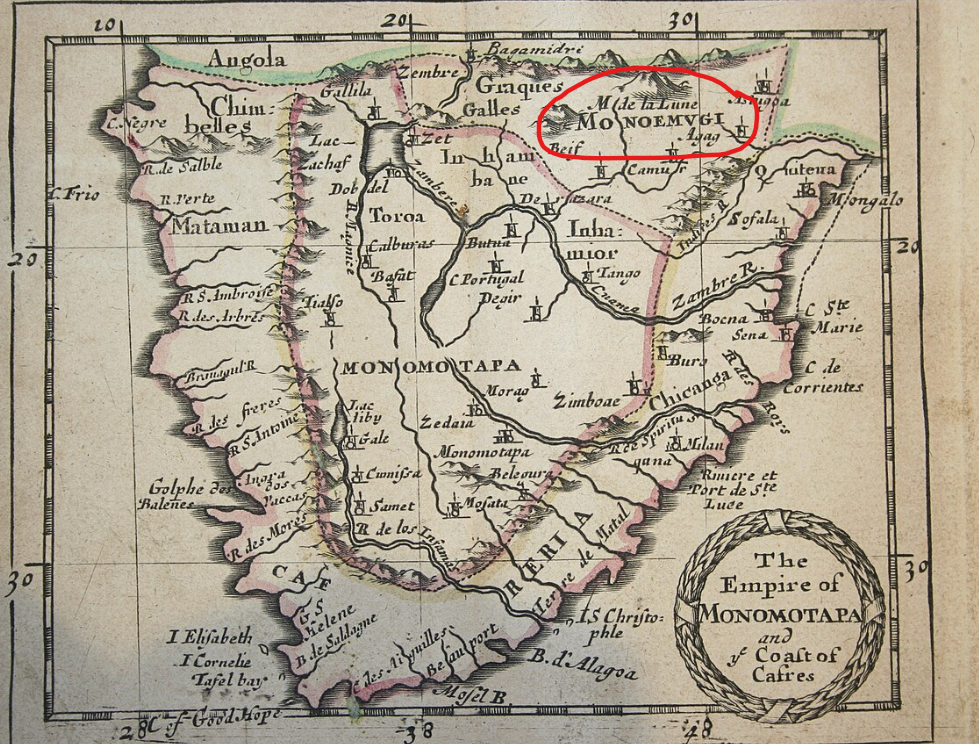
- History of Navigation (J.H. Van Linshoten, 1638) [3] states :
« The Monemugi is a great expanse between the Monomotapa and Ethiopia, on the west side of the Nile, between two lakes. He is in peace with neighbourings kingdoms, except with the Monomotapa, with which with which it had been embroiled in bitter wars ».
« The Kingdom of Monoemugi or Nimeamaye is in the depths of Southern Africa, being one of the most distant to the coast and having on the North Abyssinia and the land of the great Makoko, on the South, the Monomotapa and Mozambique, and on the East Mombasa and Kilwa ».
- The Encyclopedia Britannica [4] states :
« MONEMUGI, an empire in the south of Africa, has Zanguebar on the east, Monomotapa on the south, Motamba and Makoko on the west, and Abyssinia on the north and partly to the east, though its boundaries that way cannot be ascertained. It is divided into the kingdoms of Mujaco, Makoko or Anfiko, Gingiro, Cambate, Alaba, and Monemugi Proper. This last lies in the middle of the torrid zone, and about the equinoctial line, south of Makoko, west of Zanguebar, north of Monomotapa, and east of Congo and of the northern parts of Monomotapa. To ascertain its extent, is too difficult a task, being a country so little frequented. The country known, abounds with gold, silver, copper mines, and elephants. The natives clothe themselves in silks and cottons, which they buy of strangers, and wear collars of transparent amber beads, brought them from Cambaya: which beads serve also instead of money; gold and silver being too common, and of little value among them.
Their monarch always endeavours to be at peace with the princes round about him, and to keep an open trade with Quitoa, Melinda, and Mombaza, on the east, and with Congo on the west; from all which places the black merchants resort thither for gold. The Portuguese merchants report, that on the east side of Monemugi there is a great lake full of small islands, abounding with all sorts of fowl and cattle, and inhabited by negroes. They relate also, that on the main land eastward they heard sometimes the ringing of bells, and that one could observe buildings very much like churches; and that from these parts came men of a brown and tawney complexion, who traded with those islanders, and with the people of Monemugi. This country abounds in palm wine, oil, and honey. »
- The Calendar of State Papers Colonial, East Indies, China and Japan, Volume 2, 1513-1616 (March 1600) [5] states :
« Quiloa, Mombaza [Mombaca], and Melinde [Melinda], all possessed by the Portugals; the people Mahometans, and acknowledge the great kingdom of Monemugi [Mano–emoogi], whose king barters gold, silver, copper, and ivory with the Portugals for cotton and linen »
In summary, all these reports states that :
- A state call Monemugi existed in the Interior of Africa at the time the Portugese were sailing around Africa.
- It was located south of Abbyssinia, north of Monomotapa, east of Kongo and west of the coastal towns of Kilwa, Malindi and Mombasa.
- This state maintained trade relation with the coastal towns (Kilwa, Mombasa, Malindi).
- This state was located between two lakes, and on the west side of the Nile.
- The state was among the most important of Africa and was considered as an empire with several provinces
The meaning of the name “Monemugi” :
The name « Monemugi » is the transcription under european phonetics of an African name (probably « bantu »). This term can be compared to the name « Monomotapa », which also designates an important African empire, this time in southern Africa.
Thus, the word « Monemugi » can be subdivided in 2 parts :
- Mono/Mone/Monoe : which ,means lord, master, ruler in languages of Central Africa and which is found in titles like « Monomotapa », « Mani-Kongo »…
The African word behing the term « Mono » is probably the word « Mwene » which means lord or master or maybe the word « Mwami » which means king in many East and Central African cultures.
- Mugi/Muge/Muji : probably linked to the word « mwezi » : the moon, in many bantu languages of East (kiswahili, chichewa, nyanja…)
The word Monemugi would then originally be « Mwene mwezi » : The Lord of the Moon.
This word is to be compared to current words still in use in the Great Lakes region :
- Nyamwezi/Unyamwezi : ethnic group of northwest Tanzania, on the shores of Lake Victoria, whose name mean « those of the Moon ».
- The Cwezi dynasty and clan, which have reigned over the Kitara empire some centuries ago.
- The royal name « Mwezi » (Moon) bear by the kings of Burundi, such as King Mwezi Gisabo (1840-1908), who reigns during the arrival of the Germans in East Africa.
All these elements put together, it seems that the Monemugi empire designated a great political entity established in the Great Lakes region, several centuries ago.
These elements bring us to the next question which is : Is there an indigenous tradition among East African people of a large empire existing between 900 CE and 1500 CE in the region ?
The answer is unequivocally : Yes !
The oral traditions of the Cwezi dynasty :
Among the Banyoro, Banyankole, Batooro, Baganda of Uganda, and among the people of Karagwe, Buzinza, Ihangiro of Northwest Tanzania, there is a strong set of traditions [6] (collected in the 19th century by European explorers and missionaries in royal courts and among rural clan traditions) recalling a great empire ruled by a dynasty called Bacwezi which existed several centuries before European arrival (around 14th-15th century) and from which the dynasties of current kingdoms (Buganda, Bunyoro…) and chiefdoms descend. This kingdom is considered to have covered a large part of the Great Lakes region and the ruins and structures of Bigo and Ntusi in Western Uganda are considered to be remains of the capital or royal sites of this Empire.
In conclusion :
By analyzing all these informations, one can make a strong historical hypothesis that the Kingdom of the Zanj described by Arabic sources, the Monemugi empire mentionned by Portugese sailors and the Cwezi empire of East African oral traditions are one and the same state : the Empire of Kitara, which ruled over the Great Lakes region between at least 9th century to the 15th century.
References :
[1] The Meadows of Gold : The Abbasids. Al Masudi. 947 CE (English edition by Paul Lunde and Caroline Stone – 1989)
[2] Relatione del Reame di Congo et delle circonvicine contrade tratta dalli scritti & ragionamenti di Odoardo Lopez Portoghese. Filippo Pigafetta. 1591
[3] History of Navigation. J.H. Van Linshoten. 1638
[4] Encyclopedia Britannica 5th Edition – Volume 14 – 1815.
[5] Calendar of State Papers Colonial, East Indies, China and Japan, Volume 2, 1513-1616. March 1600.
[6] Abakama ba Bunyoro-Kitara. J.W. Nyakatura. 1933.
 Empire of Kitara
Leave a comment